
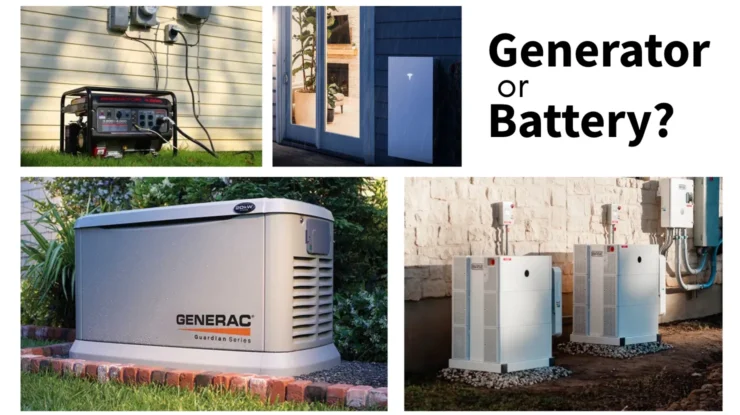
A whole-home standby generator can run for days but costs around $18,000-$20,000. A portable generator is the cheapest way to keep essentials running, but it takes the most work and carries a risk of carbon monoxide poisoning if not managed properly. A home battery is silent, switches over instantly, and covers a typical one-day outage. Plus the newest version of home battery backup comes with a low upfront installation and a subscription fee.
The right pick depends on how long a typical outage lasts in your area, what you need to keep running, and what you can spend.
Side by Side Comparison: Battery vs. Generator
There are 4 basic options for your Texas home. You can lease or own a home battery backup system, install a whole-home standby generator or use a portable generator.
| Leased Home Battery (Base, Energywell) | Owned Home Battery (Tesla Powerwall 3) | Whole-Home Standby Generator | Portable Generator |
|
|---|---|---|---|---|
| Upfront cost | <$700 install fee | $13,000 to $16,500 installed | $12,000 to $18,000+ installed | $800-$1200 for the generator, plus $1000 for electrical and natural gas connections |
| Ongoing cost | $19/month membership, 12-15 year agreement | None required | Annual service: $50 to $75 DIY, $200 to $400 dealer | Fuel, oil changes, storage |
| Capacity | 20-40 kWh | 13.5 kWh per unit | Unlimited while fuel flows | Continues to run unlimited if using natural gas; Must refuel if using gasoline or propane. |
| Typical runtime | About 24 to 36 hours depending on usage and capacity | About 12 hours for one battery, depending on usage | Days, on natural gas | Days on natural gas; 8 to 12 hours for gas or propane |
| Switchover | Instant | Instant | 10 to 30 seconds | Manual. You start it and flip the breakers. |
| Carbon monoxide risk | None | None | Low when installed to code | High if not used properly |
| Whole-home coverage | Yes | Partial or whole, depending on # of units | Yes | Selected circuits only |
| Noise | Fan hum, audible within about 5 feet | Fan hum, audible within about 5 feet | 67 to 75 dB, audible about 150 feet away | Loud. Similar to a lawn mower. |
| Fuel / site prep | None. | None | Gas line, concrete pad, permits | Gasoline or propane storage, or natural gas connection |
| Electricity plan | Must get power from a specific retail electricity company | Any plan | Any plan | Any plan |
Hybrid Approach: Battery + Portable Generator Case Study
I’ve lived in Houston for over 30 years, and had gotten used to going without lights and air conditioning during extended outages. After a catastrophic wind storm caused a 5 day outage in May 2024, followed by Hurricane Beryl and a 7 day outage in July 2024, I was done roughing it. I purchased a tri-fuel portable generator and got electrical and natural gas connections installed. As usually happens, we haven’t have a long outage since (knock on wood). I’ve yet to use it, because it’s a hassle to roll-out for short term outages, which are more common in my neighborhood.
In 2026, I installed the Energywell home battery backup. I have a 15-year lease and a 5-year electricity agreement with Energywell. When my electricity plan expires, I’ll get an offer that’s at or below the average fixed rate plan on Power to Choose. My Energywell battery has already powered my home through 3 short-term outages. If I have a long-term outage, it will last 24+ hours and I can recharge it with my portable generator.
I look at this as being the best of both worlds: a battery with instant-on for short term outages, and a portable generator for long-term outages.
Home Battery Backup Options: Lease vs. Buy
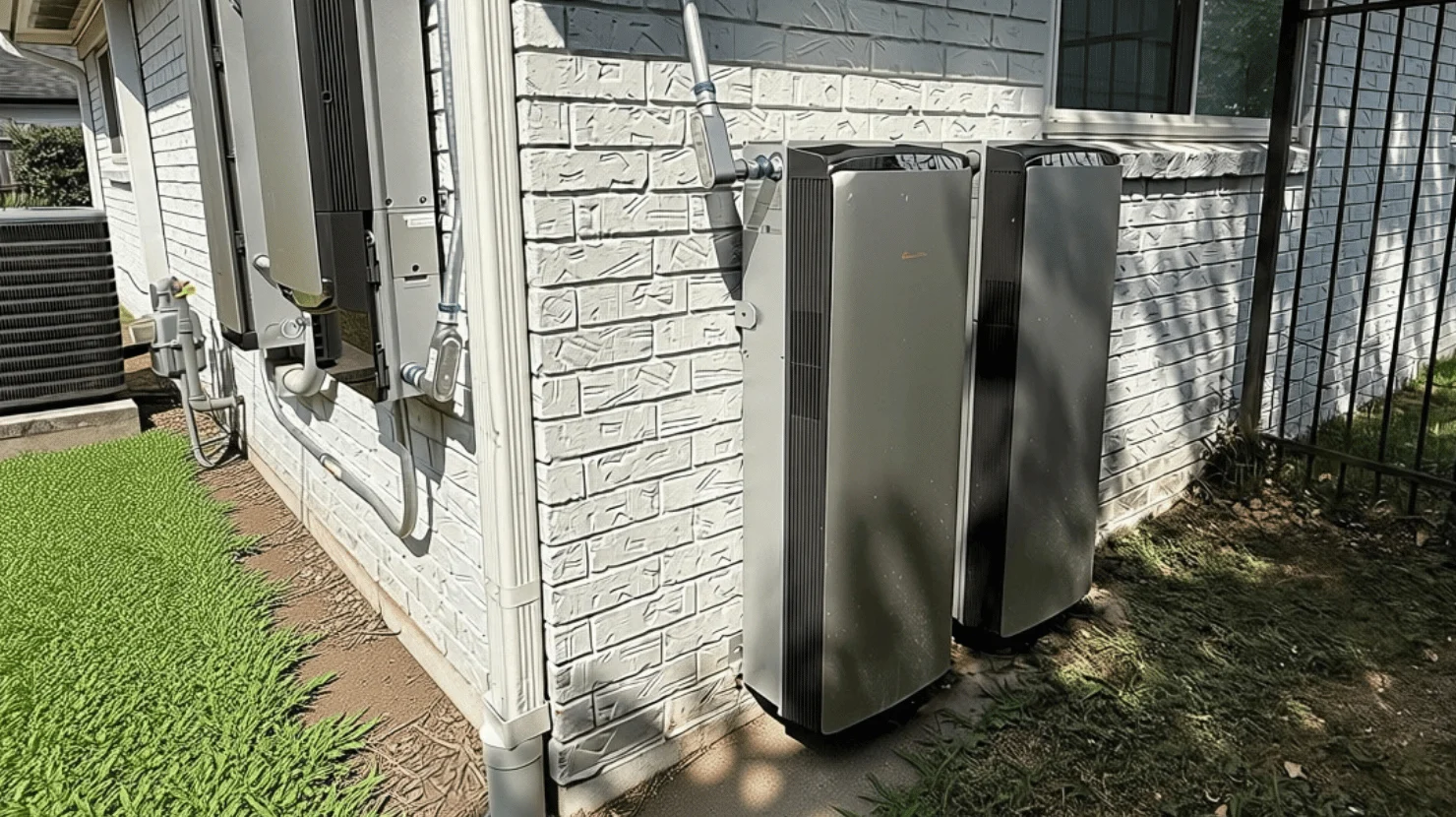
A home battery stores grid power and takes over the instant your power goes out. There is no engine, no fuel, no exhaust and no flicker. If you don’t know your power’s out, you can’t even tell. You can get one two ways in Texas: lease it through a membership model or buy it outright.
Leased: Home Battery Subscription Options
There are 4 retail electricity providers in the deregulated areas of Texas that offer home battery backup subscriptions: Base, Energywell, Tesla and Octopus Energy. We compare all four options in our article on home battery backup systems.
What works well
- Instant switchover. Your battery turns on in milliseconds. Your clocks won’t even blink.
- Quiet. You have to stand within a few feet to hear the cooling fan.
- Easy installation. No gas line, no concrete pad, no yard trenching. It can sit within inches of the house.
- No maintenance. Your provider handles any issues.
- Low upfront/low monthly fee. Installation is under $695 with monthly fees of around $19/month.
- Great solution for most outages. Most outages last less than 4 hours. For outages over 36 hours, you can recharge the battery with a generator.
What to watch
- You must switch your electricity plan. You’ll have to get electricity from the company leasing you the battery. You’ll have a fixed rate for a specific term. Your renewal rate “formula” is spelled out in your battery lease. All providers says they will meet or beat the average price on Power to Choose for a fixed rate agreement of the same contract term.
- Long-term commitment. You have a 10-15 year battery lease. Cancel (or switch away from the electricity provider) and you’ll pay an uninstall fee of $500-$1000. All leases are transferrable if you sell your home.
- Is this sufficient for my home? All battery systems have their limits. For example, a 40 kWh battery system will last 24-36 hours. If you run multiple HVAC systems, an electric dryer or a pool pump, you’ll drain the battery fast. Be prepared to make trade-offs to make it last.
So what’s the catch? Your battery will be used as part of your provider’s Texas Virtual Power Plant (VPP) program. They’ll charge the battery when prices are low and use it to power your home or sell power onto the grid to boost their profits. Each of the providers says they’ll always leave you with at least 20% of your battery available at all times. And each provider says they’ll charge the battery to 100% in advance of any major weather event.
Owned: Tesla Powerwall, Enphase, and others
Buying your home battery backup means independence from any monthly fee, lease agreement or required retail electricity provider. But it also means a large upfront cost. In Texas, a Tesla Powerwall 3 (13.5 kWh) runs about $13,000 installed.
When you own your battery system, you can choose to participate in a Virtual Power Plant program with your electricity provider. For example, with Tesla, you can switch your electricity to Tesla Power and get credit for selling your excess power to the grid.
If you decide to buy versus lease, just don’t assume that your battery will become a big money maker for you. You can not sell power from your battery directly to the grid in Texas. Only a retail electricity provider can do that through their VPP program. The buyback rate is typically under 4¢ per kWh.
Standby Generator: Whole Home vs. Portable
A whole home standby generator is a permanent engine, wired to your electrical panel and fed by your natural gas line. When the grid fails, an automatic transfer switch starts the engine and shifts your home to generator power. A portable generator gives you similar functionality at a lower cost, but you’ll do the work of managing any switch-over and do the heavy lifting of moving it into place.
Whole Home Generator
The huge advantage of a whole home natural gas fired generator is runtime. On natural gas, it runs as long as gas keeps flowing. You can outlast any power outage, whether it’s days or even weeks.
What works well
- Unlimited runtime on natural gas. The best protection for multi-day disasters.
- Powers the whole house, including central AC and electric appliances.
- No ongoing contract unless you choose a service plan.
What to watch
- High upfront cost. A 22 to 24 kW whole-home unit runs $12,000 to $18,000 or more, including the gas plumbing, concrete pad, and permits.
- 10 to 30 second gap. The engine has to start before power returns. Lights go out, and clocks and electronics reset.
- Noise. Expect 67 to 75 dB, loud enough to hear three or four houses away. It also runs a short self-test every week.
- Maintenance costs. Oil, filters, spark plugs, and the starter battery need yearly service. That is $50 to $75 DIY or $200 to $400 through a dealer. Optional monitoring and maintenance plans run $20 to $50 a month.
Portable Generator
A portable generator is the budget option. You can buy a low cost gasoline or propane generator and run extension cords into your house for your refrigerator and fans. Or, you can buy a larger tri-fuel generator and set up the connections to run it through your electrical panel and natural gas lines, and run your whole house.
The portable generator unit itself costs roughly $800-$1500 depending on the size you need. To connect safely to your home, you’ll need an interlock kit and 50 amp outlet set up by a licensed electrician, which will cost around $500-$1000. You’ll also want to hire a plumber to install a new connection to your gas line for tri-fuel generator support, for another $500-$800.
>>This article on portable generator for home backup walks through sizing and installation
What works well
- Lowest cost by far.
- Long run time. With a tri-fuel generator, it runs continuously off your natural gas line. You’ll just have to stop for oil changes.
- Flexibility. Doubles as power for camping, tailgating, or job sites.
What to watch
- Manual operation. Someone has to haul it out, connect it, start it, and flip the breakers. In a storm. Possibly at 2 a.m.
- Partial coverage. Small portable generators power essentials only, like the fridge, a few lights, fans, a window unit. However, powering your central AC is well within reach with a large generator and a soft-start on your HVAC.
- Noise. Comparable to a lawn mower, running for hours.
Health risks
In addition to being loud to operate, the risk of carbon monoxide poisoning is very real with a portable generator. After Hurricane Beryl in 2024, about 400 Texans went to the ER for CO poisoning, the highest count since Winter Storm Uri. To stay safe, never run a generator in a garage, even with the door open. Keep it at least 20 feet from the house with the exhaust pointed away from doors and windows. Make sure you have a CO detector (or multiples) in your home.
Which One is Right for You?
Match the option to the outage you actually worry about, not the worst one you can imagine. Most power outages in Texas are less than 4 hours.
| Your situation | Best fit | Why | ||
|---|---|---|---|---|
| Outages are usually a few hours to a day | Leased home battery | Instant, silent, whole-home coverage for under $700 upfront | ||
| You want protection for multi-day disasters | Standby or whole home generator | Runs for days on natural gas with no refueling | ||
| Someone in the home relies on medical equipment | Whole home generator | You need life-saving reliable power | ||
| Tight budget, essentials only | Portable generator | Keeps the fridge, fans, and phones going | ||
| You want to keep your current electricity plan | Standby, portable, or owned battery | Battery lease agreement requires switching plans in deregulated areas | ||
| HOA or tight lot limits noise and placement | Battery | Quiet, small footprint, can sit close to the house |
Frequently Asked Questions – Battery vs. Generator
It depends on what you run. A 40 kWh battery lasts about 36 hours for typical use. Running central AC, electric heat, or a pool pump can cut that sharply.
For a multi-day freeze like Uri, a natural gas standby generator is the safest bet. Electric heat draws a lot of power and drains batteries quickly. A battery paired with a portable generator for recharging is a lower-cost middle ground.
Yes, but it shortens runtime. Raising the thermostat a few degrees and skipping large appliances stretches it much further.
Only with a bundled lease like Base or Energywell, and only in deregulated areas. Buying a battery outright, or choosing any generator, leaves your plan choice open.
A portable tri-fuel generator with an interlock kit, at roughly $1,500 to $3,000 total, is the cheapest way to get back up power for your home. The cheapest whole-home option is a leased battery, at under $695 upfront plus $19 a month plus the cost of the power you use.
