
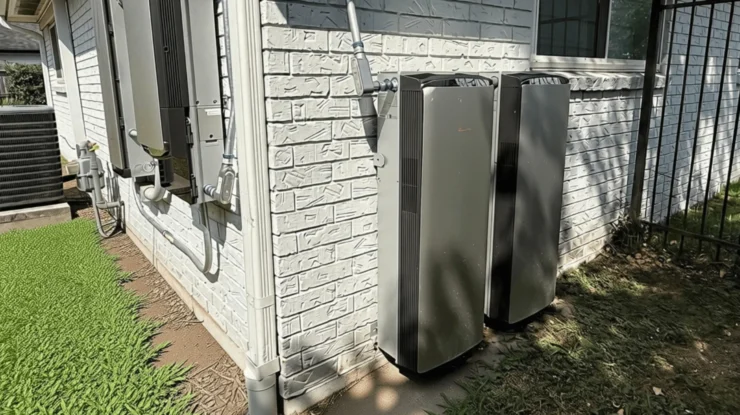
After frequent power outages at your home, you’re probably frustrated and ready to do something to keep your home operating regardless of grid conditions. New technology makes home battery backup a solid alternative to a whole home generator.
In this article we review what a battery backup system is, how to determine the size of battery you need, and the subscription model for home battery backup systems that makes it truly affordable.
What is a Battery Backup System?
A home battery backup system is a rechargeable battery installed at your home and wired into your electrical panel. It stores electricity from the grid, charging when prices are lowest. When the power goes out, it takes over automatically, usually within milliseconds, so your lights and appliances keep running without interruption.
>>Other power backup options include a whole home generator or a portable generator. See our article comparing generator vs. battery.
How Much Battery Power Do I Need for My Home?
Your battery power requirements depend on what you consider essential during a power outage. Here are the steps to take:
- Estimate your daily electricity usage needs
- Determine your peak electricity requirements
- Decide what’s essential vs. optional
Estimate Your Daily Electricity Usage Needs
According to the EIA’s Residential Energy Consumption Survey, the average household uses about 10,791 kWh per year or around 30 kWh per day. Around 50% of that is heating and cooling your home. That means most homes need 10-15 kWh of battery capacity for basic backup, while full comfort operations with HVAC require around 20-30 kWh per day.
TIP: To find your average daily usage, pull your electricity bills for August and February, which are your highest and lowest consumption months. Divide the usage on each bill by the number of days in that month. That gives you a range of your daily consumption. Cut that in half if you don’t plan to run your HVAC system during an outage.
Determine Your Peak Electricity Requirements
Your central HVAC system is your biggest peak electricity requirement and the one to focus on. It requires around 4 kW to run, but 12+ kW in starting power every time it cycles. Because central AC cycles multiple times an hour, these start-up spikes quickly drain your backup. And some smaller batteries don’t even have sufficient peak power to cycle the HVAC!
You can identify your starting power requirements by looking at the power label on the side of your HVAC unit. Look for volts and LRA (locked rotor amps), and calculate starting power as volts x amps.
Here’s a real life example. My HVAC system is older and less efficient. The label showed 208-230 volts and an LRA of 79, meaning I need 18,170 starting watts (230*79). But with a soft start installed, the starting wattage drops to around 5,500 watts, totally within the starting power of a typical battery installation.
Starting power is the extra power an appliance needs for 2-10 seconds when it first turns on, also called starting watts or peak electricity. Running power (or rated watts) is the continuous power required to keep the appliance operating.
Decide What’s Essential vs. Optional
Cooling your home to 70° while streaming movies all day is a nice to have during a power outage. But is that what you really need? Your ideal battery size and set-up should be based on what you consider essential.
Basic
You keep the lights on and the food cold, but eliminate some modern conveniences. You can run:
- Refrigerator + freezer
- Fans
- LED lights
- WiFi router + modem
- Medical devices
- Phone + laptop charging
Comfort
You keep the lights on and the food cold, and stay comfortable.
- Basic level, plus:
- Central HVAC at 50%
- TV + streaming
- Microwave
- Multiple device charging
Luxury
Your whole house runs as normal, with no changes to your lifestyle.
- Comfort level, plus:
- Central HVAC at normal usage
- Electric clothes dryer
- Dishwasher
- Electric stove/cooktop
How Long Will My Battery Last?
How long your battery lasts during a power outage depends on the battery size (total kWh) and your usage habits.
If you focus only on basic needs, you could power your home for 24-48 hours with a single 13.5kWh battery. But add in HVAC, even at a reduced cycle time, and you’ll cut your battery backup time considerably.
TIP: Most home battery backup systems come with an app that estimates your remaining battery backup charge based on your current usage vs. reduced usage. These scenarios come in handy when you’re looking at an extended power outage.
Here’s the formula to calculate how long your battery will last based on your wattage requirements.
Backup hours = (Battery kWh x 1000 W/kWh x.85 efficiency factor) / wattage needs
For example, in our Comfort scenario, you’re powering 1,600-3,000 watts. We’ll use the mid-point of 2,000 watts for simplicity.
Backup hours = (27 kWh battery x 1000 x .85)/2,000 watts needed
Backup hours = (27,000 watts x .85)/2,000 watts
Backup hours = 22,950/2,000 = 11.5 hours
Using this math, a 2-battery 27 kWh Tesla Powerwall 3 configuration will run your 2000W electrical load for approximately 11.5 hours.
According to Base Power Company, 97% of outages in Texas are less than 2.5 hours long. Federal power outage records from 2014-2025 show that 50% of major events (10,000+ people) are resolved in 3.3 hours.
Home Battery Backup – Cost to Purchase
Want to purchase a battery backup system for your home? It’s pricey. Of these options, only the Tesla Powerwall would be able to start your central AC. Their low continuous output capacity means you’ll have to buy multiple units to get more than a few hours.
| Tesla Powerwall 3 | Enphase IQ Battery 10C | Sonnen Core+ |
|
|---|---|---|---|
| Capacity | 13.5 kWh usable | 10 kWh usable | 10 kWh usable |
| Continuous Output | 11.5 kW | 7.08 kW | 4.8 kW |
| Peak Output | 30 kW | 10.5 kW | 10 kW |
| Can Power HVAC? | Yes | No | No |
| Installed Cost | $13,000-$16,500 | $12,000 - $14,500 | $12,000 - $16,000 |
The conclusion you’re probably reached? Buying a home battery backup system is expensive.
Home Battery Backup Lease – Subscription Model
Base Power Company, Energywell, Tesla and Octopus Energy are Texas electricity companies that offer a home battery subscription model instead of purchasing a battery backup. You’ll get a battery backup for your home and purchase your power through a specific provider. And the configurations they offer will be enough to put you in the Comfort category, powering your HVAC system.
We provide full information on these options on our Home Battery Backup page, but here are some comparison details of available options.

Energywell
- $0 installation fee
- 20 or 40 kWh battery
- 15 year battery agreement
- $19 monthly fee
- 4.2¢ energy rate for 1 year*
- $0 application fee
- Up to $250 ETF reimbursement

Base Power Company
- $695 installation fee
- 25, 39.2, 50 kWh options
- 12 year battery agreement
- $19 monthly fee
- 7.7¢ energy rate for 3 years
- $50 refundable deposit
- Up to $150 ETF reimbursement

Octopus PowerStore
- $0 installation fee
- 30 kWh battery
- 10 year battery agreement
- $45 monthly fee
- 8¢ energy rate for 3 years
- $0 deposit
- Unknown ETF reimbursement

Tesla Electric
- $100 installation fee
- 27 kWh batttery
- 12 year battery agreement
- $35 monthly fee**
- 8¢ energy rate for 1 year
- $0 deposit
- Unknown ETF reimbursement
In conclusion, a home battery backup system can be a great option to provide backup power for your home. Buying a battery backup system can be expensive. That makes home battery subscription options that combine battery + energy an attractive option and a low-cost win for Texas homeowners.
